I work at Opta Information Intelligence, a Verisk company, where I write the Python that turns municipal open data into standard civic address and parcel layers for Canadian provinces and territories, and the checks that stop a bad update before anyone uses it.
Before that I studied geography at South China Normal University and geomatics at the University of British Columbia.
Work
GIS Developer, Opta Information Intelligence
2025 – present
Maintain the Python and ArcPy pipelines behind civic address layers for 11 provinces and territories and parcel layers for 10.
Adapt field mappings as municipal schemas change, and source municipal open data where provincial coverage has gaps.
Write QA scripts that flag a source when its numbers fall outside per-source thresholds. Flags are reviewed by hand before anything is reprocessed.
Added a check that stops a run on empty output, after tracing an Alberta layer that came out empty with no error.
Traced how the team's two-way AWS S3 sync could overwrite colleagues' updates, and built a safer way to sync one geodatabase at a time.
Planning intern, Guangzhou
2023
Mapping and UAV data processing at the Guangzhou Urban Planning and Design Institute, then a summer checking parcels against regulatory plans at the city's planning and natural resources bureau.
Downloads civic address points from public municipal ArcGIS services, maps each city's schema onto one standard, and runs quality checks before the output is used. On Thunder Bay's 45,102 addresses the parser agrees with the city's own split fields on 99.95% of rows. Most of the rest turned out to be records where the city's fields disagree with each other.
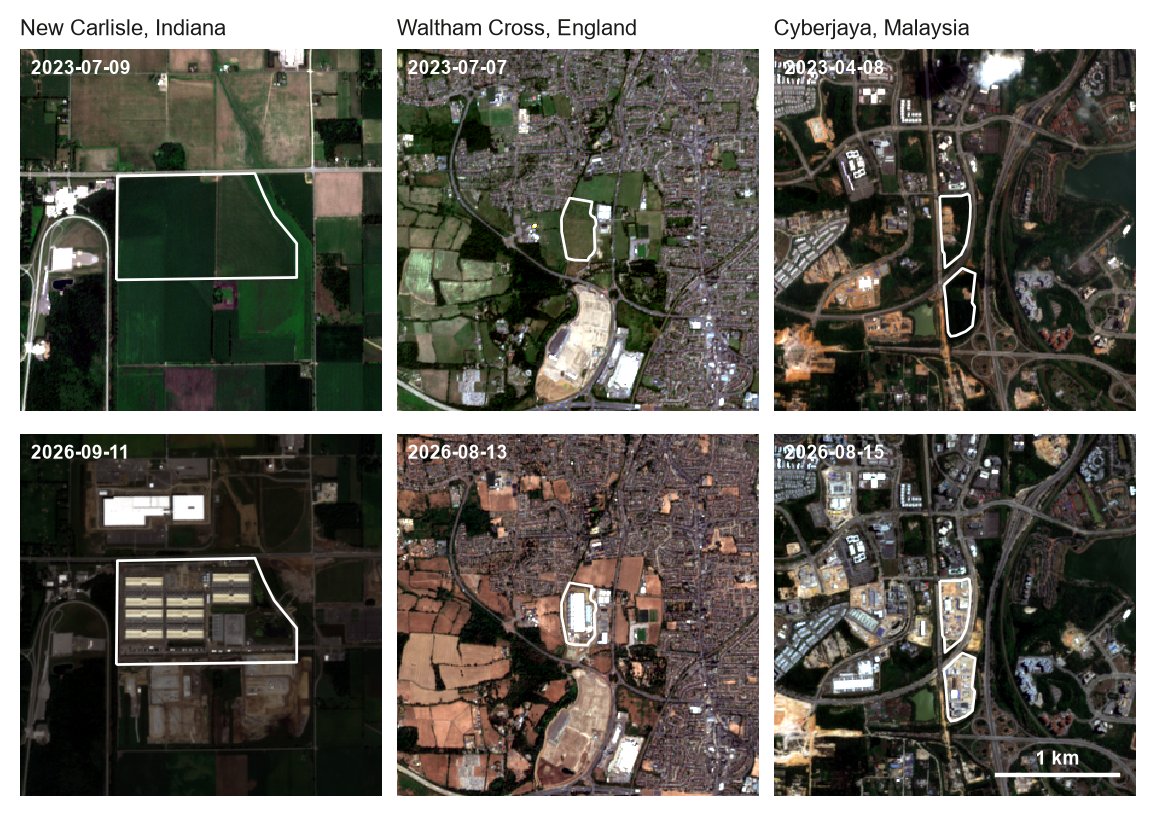
Data centres have become a land use fight, but nobody had measured what land they take. I took the 2,378 data centre campuses mapped in OpenStreetMap across 101 countries and read their footprints against annual 10 m land cover, GHSL population and Sentinel-2 imagery. The 215 campuses built from 2018 to 2023 replaced 1,376 ha, 42% of it cropland, and in the US the global map agreed with the USDA crop map within three points. Before 2017, about a quarter of campuses were on rural land. Since then, 79% have been. Compared with the land within 5 km, though, new footprints hold no more cropland than their surroundings, so the farmland follows from which region campuses go to, not which parcel they pick. Of 146 campuses still unbuilt in 2023, 89 show construction-scale change by 2026. Written up as a preprint, not peer reviewed, with an interactive map of every campus. OpenStreetMap covers China, India and Alberta poorly, so the totals are for mapped campuses only.
Three campuses from 2023 to 2026: an Indiana field, a grass field north of London, and a site in Cyberjaya.
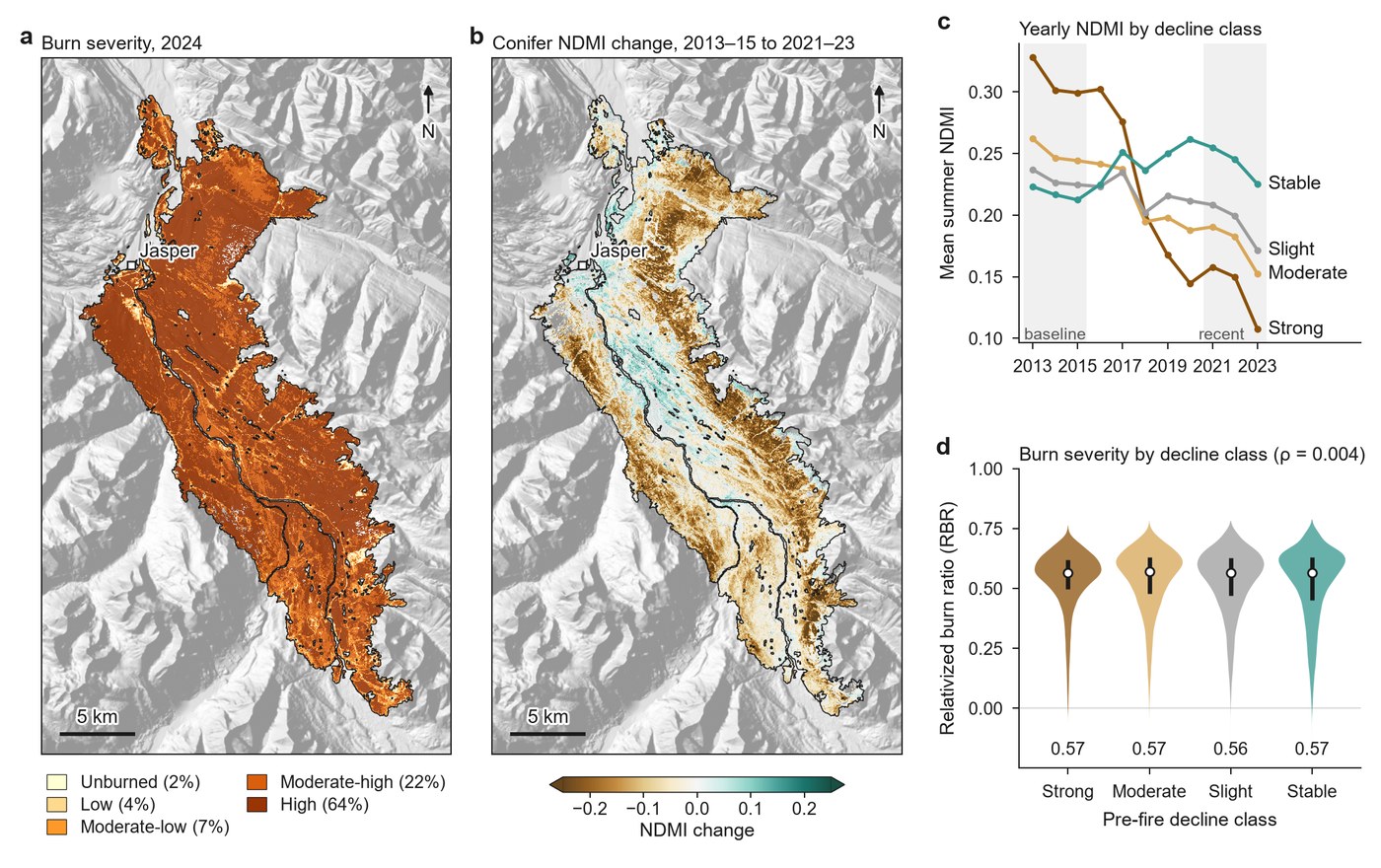
Mountain pine beetle had killed much of the pine around Jasper before the 2024 wildfire, and I wanted to know whether those stands burned more severely. I mapped burn severity from Sentinel-2, pre-fire decline from eleven years of Landsat, and canopy loss from the 1 m LiDAR flown before and after the fire, then ran the same workflow on the 2023 McDougall Creek fire above West Kelowna. In neither fire did declined stands burn more severely, and adding decline to models that already had terrain, stand structure and fire weather improved them by about 0.02 R² on land they had not seen. The second fire showed that in a logged forest the decline map mostly finds clearcuts, so harvested areas now come out first. Google’s AlphaEarth embeddings predicted severity slightly better than my own predictors in both fires. The decline maps have not been checked against field surveys.
Jasper: burn severity, pre-fire change in conifer moisture, and how the two compare.
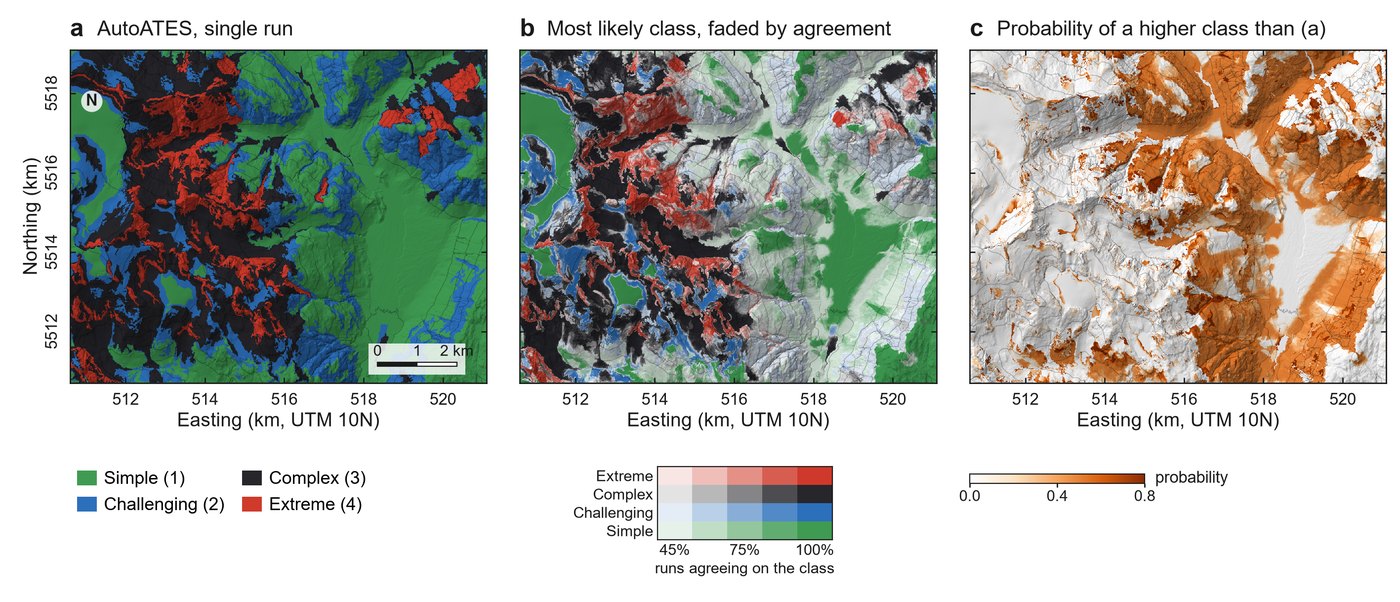
AutoATES rates avalanche terrain from an elevation model and a forest layer, and gives each cell one class with no sense of how far to trust it. I rewrote the model chain so it runs in seconds, checked it against the original code and data, and reran it hundreds of times with perturbed elevation, forest and threshold inputs. The probabilities were tested on five lidar-covered blocks, each scored with an error model fitted on the other four, and against two expert benchmark maps. Built from province-wide data, a single map matched the lidar-based one on 56% of the Coast Mountains terrain. The ensemble was nearly calibrated and pointed to the cells most likely to be wrong, but against a fair baseline it improved the Brier score by only 11%, so its real use is telling reviewers where to look. Forest cover, not elevation, was the largest source of uncertainty. Manuscript draft. A research exercise, not something to plan a route with.
One AutoATES run, the ensemble's most likely class faded by agreement, and the chance the class is higher.
Land cover change at Cable Bay, BC
UBC, 2024–2025
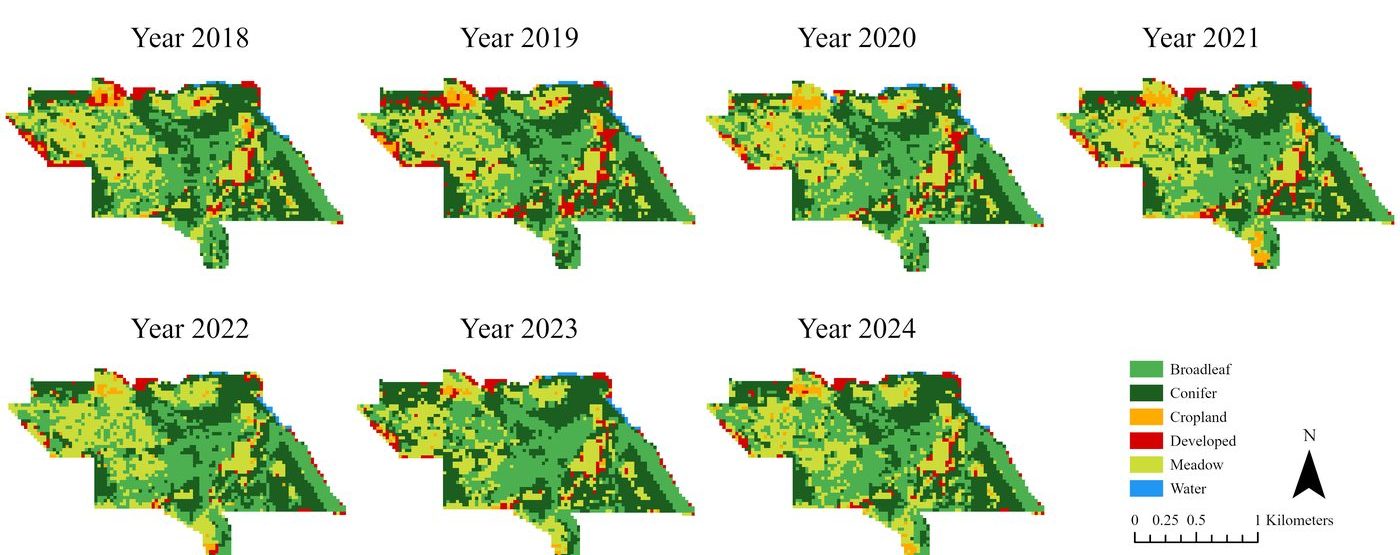
Classified Sentinel-2 imagery for each year from 2018 to 2024 with a Random Forest model in Python (97.0–98.6% overall accuracy), then used transition matrices and Getis-Ord Gi* hotspots to see where forest and meadow were giving way to development.
Annual land cover, 2018–2024.
Salmon access on eastern Vancouver Island
UBC coursework
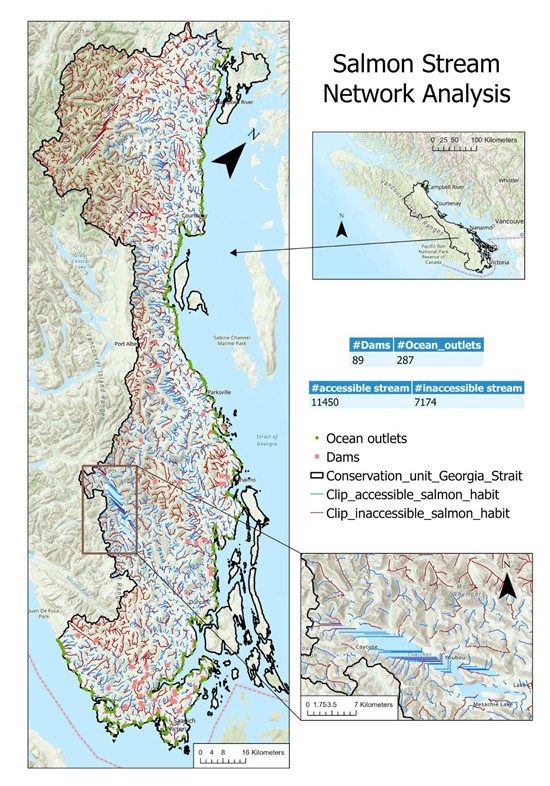
Derived a stream network from a DEM in ArcGIS Pro for the Georgia Strait conservation unit and marked which reaches salmon can still reach from the ocean. With 89 dams in the area, 11,450 stream segments came out accessible and 7,174 cut off.
A static, installable page for each trip: day-by-day plans on a Leaflet map, booking countdowns, cost splitting and calendar export, all usable offline. A shared engine checks each trip's content before the page loads. Live site.